
CarCollectorsClub.com | case study
MULTI AGENT ORCHESTRATION
“How CarCollectorsClub.com used AI workflow orchestration to automate event discovery, data validation, content creation, content updating, and multi-channel social syndication across Car Shows, Car Auctions, and Car Clubs.”
Overview
CarCollectorsClub.com is a content-driven automotive media platform serving collectors and enthusiasts through articles, event calendars, and club listings. As the business expanded, its biggest challenge was not a lack of content opportunities, but the growing operational burden required to keep hundreds of recurring events, articles, and directory records accurate, current, and publish-ready.
Background
Much of the company’s day-to-day operation depended on repetitive manual work across three core categories: Car Shows, Car Auctions, and Car Clubs. Employees had to research upcoming events, verify changing dates and venue details, clean and reconcile data between WordPress and Google Sheets, write or update articles, and distribute content across multiple social platforms.

These business processes were essential to growth, but they were also slow, labor-intensive, and difficult to scale. As content volume increased, manual workflows began creating operational bottlenecks that reduced publishing speed, increased labor cost, and made it harder to maintain data quality across the organization.
The Problem
The core business problem was workflow inefficiency across a high-volume content operation. Important information was constantly moving among websites, spreadsheets, WordPress records, and publishing tasks, yet much of it was still manual. This created unnecessary friction in the operating model and introduced risks such as outdated records, duplicated effort, missed publishing opportunities, and inconsistent data across systems.
In practical terms, the company needed a better way to manage upstream data ingestion, data validation, record synchronization, article generation, and downstream publishing and distribution without continuing to add manual labor.
The Solution
To solve this, I designed and implemented a Multi-Agent Orchestration Engine built around AI-assisted automation, structured data pipelines, API-driven workflows, and a Google Sheets control layer that functioned as a practical business command center. Using n8n as the workflow orchestration platform, I integrated Google Sheets, ChatGPT, Gemini, WordPress, Gmail, and Telegram to create eight specialized multi-agent workflows across content, data, and publishing operations.

Workflow Integration Tools Include Google AI Studio, Google Sheets, VS Code, ChatGPT, Gemini Pro, WordPress, n8n, Gmail, Telegram, etc….
The result was a connected set of end-to-end workflows capable of discovering new opportunities, validating and normalizing incoming data, reconciling WordPress and spreadsheet records, generating or updating articles, and triggering social syndication across multiple channels. Each workflow operated as a specialized AI Agent within a broader Business Process Management (BPM) framework, allowing the company to replace fragmented manual tasks with a more scalable, autonomous, and operationally efficient publishing system.
The workflows were organized into three core business categories:
- Car Shows — Event discovery, venue validation, article creation, article updates, publishing sync, and social distribution
- Car Auctions — Auction data sync, event discovery, venue reconciliation, new article generation, metadata sync, and social media distribution
- Car Clubs — Directory data verification, record reconciliation, article generation, and content distribution
Together, these workflows function as a coordinated 24/7 Digital Workforce with guardrails, persistent state tracking, and one-click activation for workflow management.

Result and Business Benefit
The result was a faster, more accurate, and more scalable content production framework built to support real business operations. What had previously been a labor-heavy collection of disconnected tasks became a structured orchestration framework capable of handling research, validation, publishing, synchronization, and promotion with far greater speed and consistency.
By replacing repeated manual effort with AI-assisted workflow automation, CarCollectorsClub.com gained higher operational velocity, improved data quality, better publishing continuity, and a stronger foundation for business growth. The system reduced time spent on repetitive work, lowered the cost of maintaining content operations, and expanded the company’s ability to publish more content without proportionally increasing payroll.
In short, this case study demonstrates how multi-agent workflows, data pipelines, and AI-driven business process automation can transform a small business from a manually constrained publishing model into a more efficient, scalable, and cost-conscious digital operation.
CarCollectorsClub.com | case study
CAR Shows
#1: The Car Shows Multi-Agent Orchestration Framework
““A high-velocity AI workflow using six specialized autonomous agent workflows for end-to-end car show discovery, data validation, SEO authoring, publishing automation, and omnichannel social post syndication.””
Car Show Multi-Agent Workflow Overview
The Strategic Problem: Breaking the “6-Hour” Research Gap & The Cost-Prohibitive Content Ceiling
The Problem: Managing a global car show database, calendar, and generating new articles for each event was an operational nightmare that stalled company growth. For every single event, a staff member had to visit dozens of URLs to verify addresses, cross-reference venues, and manually extract granular details like celebrity appearances and featured car classes.
This exhaustive “detective work,” followed by SEO-content drafting and social media syndication, required an average of over six hours of manual labor per event. Keeping an accurate, up-to-date calendar of events and constantly generating event articles was becoming cost-prohibitive as a business model for a human team. For a growing platform like Car Collectors Club, this created a massive “Content Ceiling” where maintaining the massive event calendar and content volume was financially and physically impossible.
The Solution: I engineered a modular Multi-Agent Architecture that functions as a 24/7 Digital Workforce. Utilizing n8n Orchestration, I developed a Command Interface that allows for One-Click Activation. This system automates the entire End-to-End Workflow—from Autonomous Discovery Sweeps to final Parallel API Execution—all triggered by a simple checkbox toggle in a Google Sheet.
The Result: The 6-hour manual workload has been compressed into a sub-10-minute automated cycle. This transition ensures that the Car Collectors Club master calendar remains 100% accurate and up-to-date with zero manual searching. By removing the research and drafting bottleneck, the business has achieved Operational Velocity, allowing for 10x content growth while maintaining a “First-to-Market” competitive advantage.
Major Benefits & ROI: This Multi-Agent Architecture delivers a massive return on investment by automating over 2,400 hours of manual labor annually—a direct savings of over $52,800 in yearly wages. The One-Click Activation framework allows non-technical staff to manage high-intelligence AI workflows without specialized training. This shift from manual labor to Automated Data Stewardship ensures elite accuracy across the entire event database and opens the door for new revenue opportunities that were previously impossible to pursue.
#1: Car Show Data Sync Workflow
“An automated workflow that pulls car show records from WordPress into Google Sheets, using Data Ingestion, Normalization, and Synchronization to create a clean working layer for review and downstream processing.”
The Problem: Internal tracking sheets and website data frequently became “de-synced,” leading to Data Drift, manual double-work, and a loss of database integrity.
The Solution: I engineered this agent to act as a digital bridge, establishing a Self-Healing Staging Layer that automatically synchronizes WordPress event data with a Master Google Sheet via HTTP API requests.
The Result: Management gains a real-time, high-level view of the entire Publishing Lifecycle from a single spreadsheet. This ensures the “Source of Truth” is always accurate, transforming a multi-day manual audit into a sub-10-minute automated execution.
Definition: A State Management Orchestrator that performs bi-directional synchronization between the WordPress database and a centralized Google Sheet. It utilizes Boolean Logic (Filter nodes) to identify and stage High-Fidelity Data for processing, ensuring the system maintains 100% accuracy across all platforms.

(Click Image To Enlarge)
#2: Car Show Event Discovery and Validation Workflow
“An AI Agent-powered workflow that finds upcoming car show events and verifies the details, using Data Validation, Normalization, and Schema Mapping to create accurate records for tracking and publishing.”
The Problem: Identifying upcoming car show dates required an employee to manually visit dozens of URLs, taking up to 20 hours of “detective work” per week.
The Solution: An autonomous research agent constantly monitors the web to identify new event schedules, ticket prices, and featured car details.
The Result: The discovery phase is fully automated, delivering fresh data the moment it is published online and eliminating the need for manual web searching.
Definition: An Autonomous Data Acquisition Engine that utilizes programmatic web scraping and AI-driven discovery to ingest raw event data into the tracking ecosystem.

(Click Image To Enlarge)
#3: Car Show Venue Validation Workflow
“An automated workflow that uses Multiple AI Agents to validate venue records, correct inconsistencies, and create missing entries, using Schema Matching, Data Validation, and Reconciliation & Synchronization to maintain clean event data.”
The Problem: Manually matching new event data to existing WordPress Venue and Organizer IDs was a slow, technical bottleneck. Human error—such as typos or duplicate entries—frequently led to Data Fragmentation, corrupted the database, and broke website links.
The Solution: This agent acts as a digital auditor, performing Recursive Data Validation by “interrogating” the WordPress database to automatically match new entries with existing records. It scrubs “dirty” data, fixes encoding errors, and standardizes all formatting within the Self-Healing Staging Layer before it reaches the production site.
The Result: 100% Database Integrity is maintained. New events integrate perfectly with the website’s complex architecture, ensuring a professional user experience and a stable, searchable event calendar while eliminating the risk of link rot.
Definition: A Data Integrity & Normalization Agent that performs automated entity matching and Schema Validation. It ensures all incoming leads are converted into High-Fidelity Data that meets the strict technical standards required by the WordPress REST API, preventing database bloat.

(Click Image To Enlarge)
#4: Existing Article Update Workflow
“An automated workflow that uses Multiple AI Agents to update existing car show articles with validated event data, using Content Transformation, SEO Enrichment, and Synchronization to preserve search value and publishing continuity.”
The Problem: Managing a database of over 400 annual car shows was an operational nightmare. Each event required six hours of manual “detective work” to verify details and draft content. This <b “>2,400-hour annual workload created a “Content Ceiling” where maintaining an accurate calendar was financially and physically impossible. For a growing platform, this manual model was cost-prohibitive and stalled company growth.
The Solution: I engineered an Agentic Content Refactor that identifies existing website assets and “refreshes” them. By utilizing Precise REST API Injection, the agent surgically updates event dates and research discovered by the AI Scout, maintaining the original URL structure while updating the internal content.
The Result: The website remains authoritative and highly ranked on Google without a single minute of manual rewriting. This automation ensures 100% Dynamic Accuracy, allowing high-value content to stay current and competitive in search results indefinitely.
Definition: An LLM Content Refactoring Pipeline that utilizes agentic reasoning to update existing WordPress posts. It maintains SEO relevance through Automated Context Injection, ensuring “Evergreen” assets stay technically accurate throughout the entire Publishing Lifecycle.

(Click Image To Enlarge)
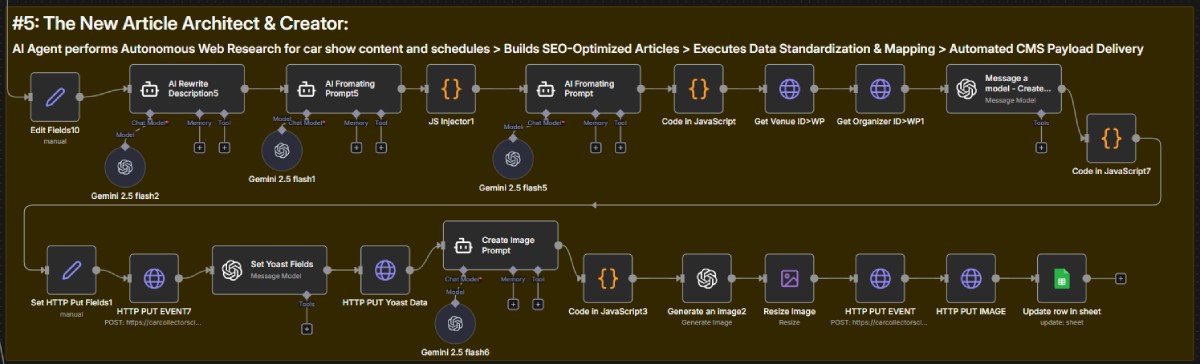
#5: The New Article Architect & Creator
“An automated workflow that builds new car show articles and custom images from validated event data, using Dual Multi-Agent Orchestration, Content Generation, SEO Enrichment, and API Delivery to produce ready-to-publish WordPress assets.”
The Problem: Producing high-quality, 1,000-word event articles traditionally cost the company $120–$240 in human labor per post. This high cost made it impossible to scale content production without a massive, expensive editorial team.
Writing one quality car show article took 5 to 7 hours. Staff had to research lot numbers, vehicle details, pricing, venue data, schedules, and admission information. Across 25+ auction houses and 100+ auctions each year, this created a costly content bottleneck.
The Result: Content production costs are slashed by over 95%. This Framework turns an 8-hour manual writing task into a near-instant process, allowing the business to increase its Operational Velocity and publish 10x more content with the same-sized team.
Definition: A Multi-Agent Architecture that synthesizes web research, brand voice, and Schema metadata into a structured digital asset. It manages text generation, automated image processing, and metadata tagging via the WordPress REST API, maintaining strict Guardrails for SEO and brand consistency.
(Click Image To Enlarge)
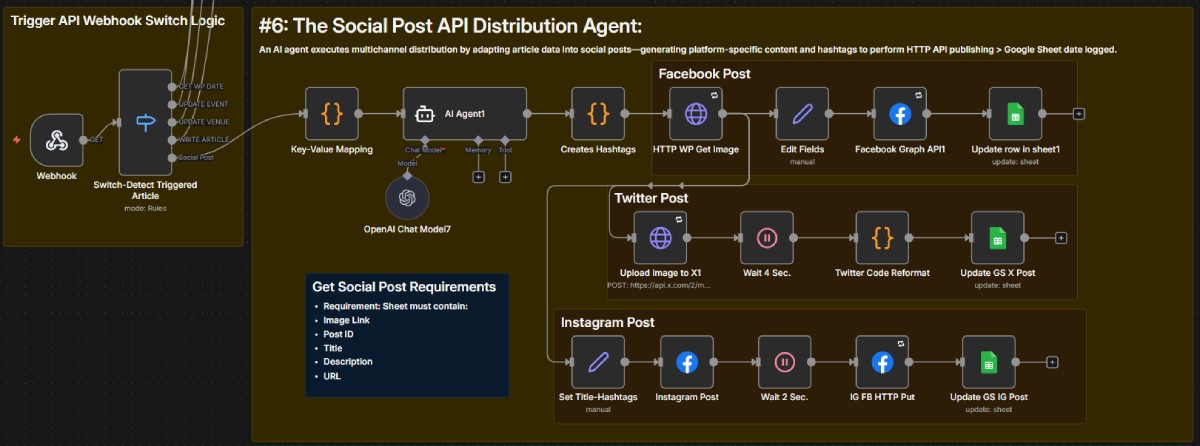
Agent #6: Social Media Distribution Workflow
“An automated workflow that turns car show articles into social media posts, using AI Content Generation, Hashtag Automation, and HTTP API Delivery to publish across Facebook, Instagram, and X.”
The Problem: Promoting new articles across Facebook, Instagram, and X (Twitter) was a repetitive, manual chore. It required an employee to log in multiple times a day to reformat text for each platform, leading to inconsistent posting and a fragmented Social Graph presence.
The Solution: I engineered a Distribution Pipeline that activates the moment an article is published. This AI Agent acts as an automated Marketing Assistant, performing Data Enrichment on the WordPress asset to custom-tailor messages and hashtags for each network while managing image Standardizing for maximum audience reach.
The Result: The brand maintains a 24/7 social presence with zero manual effort. This Framework ensures that every new article receives immediate visibility, transforming a high-cost social media management role into an automated Downstream Pipeline that keeps the audience engaged without adding to the company’s payroll.
Definition: An Autonomous Agentic Content Syndication engine that utilizes Parallel API Execution and platform-specific formatting. It intelligently maps website content to the social graph, ensuring media assets are optimized for the unique Schema requirements of each social platform via the WordPress Publishing Layer.
(Click Image To Enlarge)
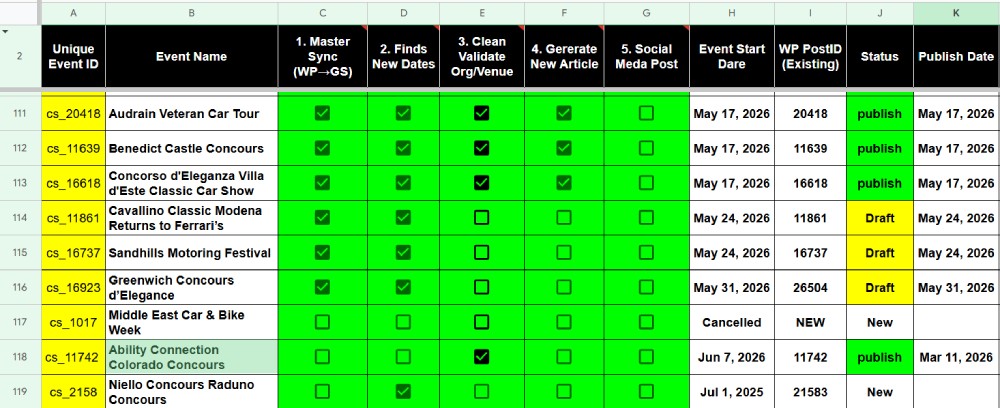
☑ One-Click Activation & Workflow Management
“The Command Center: Simple Front-End Control for Complex Back-End Intelligence”
The Problem: Managing complex AI automations typically requires technical staff to log into specialized platforms like n8n or WordPress. This creates a “Technical Barrier,” where non-technical employees are unable to trigger workflows or monitor progress without specialized training, leading to a bottleneck in Operational Velocity.
The Solution: I engineered a custom Command Interface using Google Sheets as the primary Operational Dashboard. By utilizing Webhook API Triggers, I transformed the spreadsheet into a “Remote Control.” When a checkbox (☑) is toggled, it initiates a Row-Level Transmission to n8n, which automatically identifies the requested task—whether it is Data Validation, Content Synthesis, or Social Syndication.
The Result: The entire multi-agent ecosystem can be managed by anyone with basic spreadsheet skills. This eliminates the need for technical logins, reduces human error, and allows for real-time status logging. The business now operates with a “No-Code” front-end that triggers a high-intelligence Downstream Pipeline, drastically increasing the speed of the Publishing Lifecycle.
- The Interface: The Google Sheet serves as the Operational Dashboard. No coding, technical logins, or manual data-shuffling are required.
- The Trigger: Simply toggle a Checkbox (☑) on any Car Show row to initiate the specific Downstream Pipeline required.
- The Logic: A Webhook instantly transmits the JSON Payload to n8n, where a Switch Node identifies the requested task (Validation, Syncing, or Publishing).
- The Result: The workflow executes autonomously, and the final status is logged back to the Single Source of Truth in real-time.
(Click Image To Enlarge)
Diagram: Six Multi-Agent
Workflows For “Car Shows”

This six-pipeline, multi-agent orchestration built in n8n automates the entire lifecycle of Car Show and Concours d’Elegance management. By integrating HTTP APIs with AI agents, the system synchronizes WordPress data into a Single Source of Truth (SSoT) for autonomous research, SEO content generation, and legacy article updates. It concludes with multichannel social distribution to Facebook, X, and Instagram, while maintaining human-in-the-loop oversight. This ecosystem ensures absolute Data Integrity and reduces manual labor by over 90%—transforming a complex 7-hour manual process into a streamlined, 10-minute automated workflow ….
“This Smart Dashboard turns a complex manual process into a simple, One-Click Solution. By checking a single box in a Google Sheet, any team member can instantly launch an AI Digital Workforce. This Automated Pipeline handles the ‘detective work’—automatically verifying event dates, writing SEO-ready articles, and syncing data across the entire website. This No-Code Interface eliminates the need for technical skills or manual data entry, providing Real-Time Accuracy and a massive competitive advantage with zero effort.”
(Click Image To Enlarge)
CarCollectorsClub.com | case study
CAR AUCTION
#2: MULTI AGENT ORCHESTRATION

“An autonomous multi-agent workflow ecosystem built to scale auction coverage through auction house monitoring, event discovery, data validation, SEO content creation, publishing automation, and multi-channel social syndication.”
Car Auctions Multi-Agent Overview
The Car Auctions Intelligence Ecosystem Architectural Solution
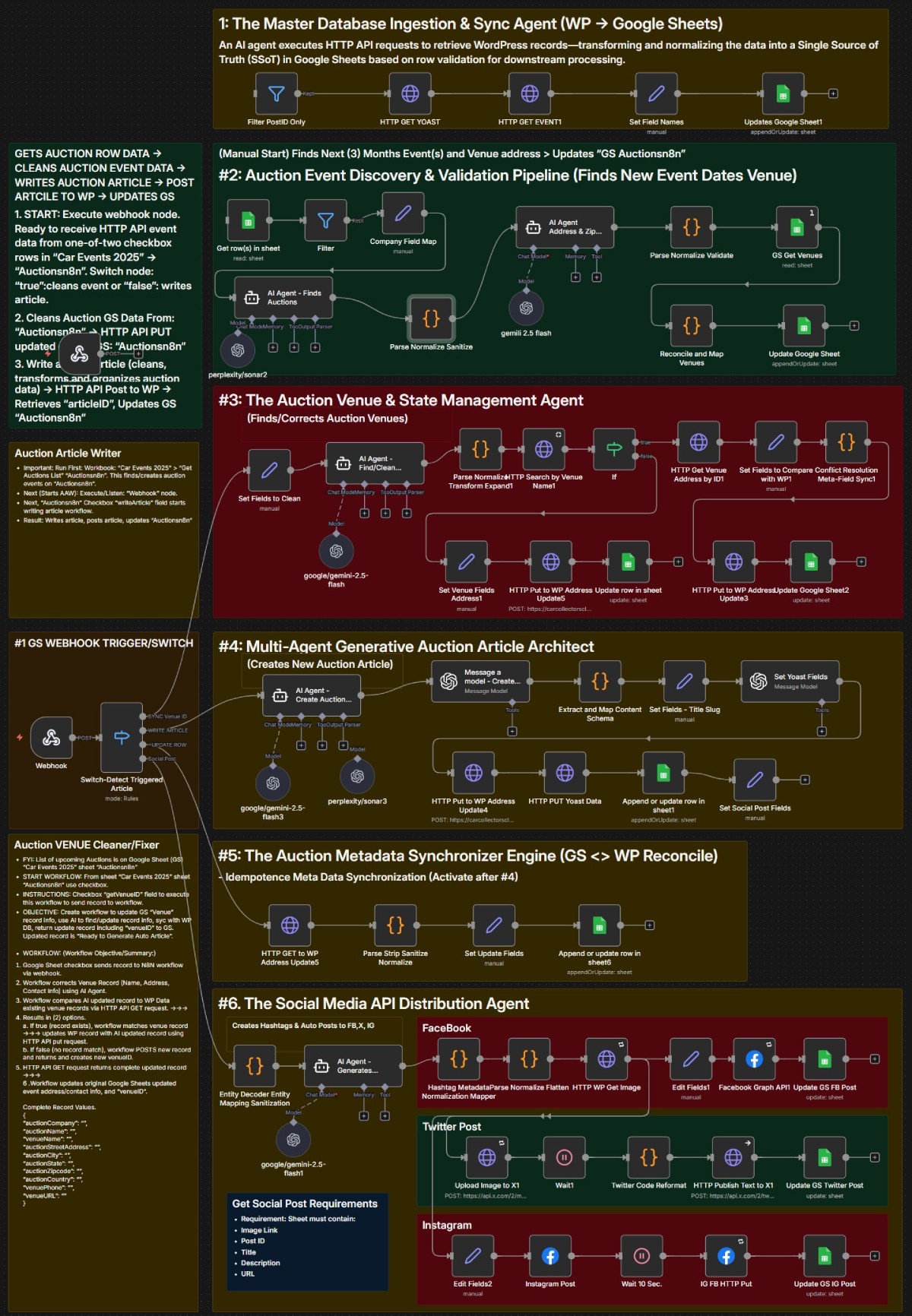
The Car Auctions Multi-Agent Workflow is a high-velocity Market Intelligence Engine engineered to dominate the end-to-end lifecycle of global vehicle lot data. By utilizing synchronized n8n Orchestration, the system transforms Google Sheets into a high-fidelity Auction Staging Layer, ensuring every data point is verified before hitting production.
Unlike standard event tracking, this Agentic Workflow is designed for the volatility of the auction market. It deploys a Multi-Agent Collaboration to execute proactive “Discovery Sweeps” across 25+ global auction houses, surgical venue reconciliation via the AEC (Auction Event Cleaner), and deep-dive content synthesis for specific vehicle lots.
This Autonomous Orchestration compresses massive catalog research into instant, SEO-ready assets, allowing Car Collectors Club to maintain a “First-to-Market” advantage while maintaining 100% data integrity across the entire digital footprint.
This Autonomous Orchestration compresses massive catalog research into instant, SEO-ready assets, allowing Car Collectors Club to maintain a “First-to-Market” advantage while maintaining 100% data integrity across the entire digital footprint.
Collectors Club to maintain a “First-to-Market” advantage while maintaining 100% data integrity across the entire digital footprint.
#1: Auction Data Sync Workflow
“An automated workflow that pulls all auction records from WordPress into Google Sheets for sanitizing, normalizing, review for downstream use.”
The Problem: At the start of a new auction season, managing legacy car show schedules across multiple calendar platforms becomes a fragmented and inefficient process. Critical event dates, venues, descriptions, IDs, SEO metadata, and historical lot details are often trapped inside the WordPress database, making high-velocity batch updates difficult. As a result, Data Validation turns into a slow cycle of individual event lookups, manual corrections, and repeated copy-pasting, increasing the risk of Data Corruption and inconsistent records.
The Solution: I engineered a high-speed Data Ingestion Engine that initiates a series of HTTP API Requests to pull live records from WordPress into Google Sheets. This agent functions as a specialized ETL (Extract, Transform, Load) pipeline, retrieving auction event data, including Yoast SEO fields and event-specific metadata, then standardizing and normalizing that information before appending it to the master Google Sheet flrdownstream processing.
The Result: The business creates an instant, high-fidelity Auction Staging Layer. By transforming raw website auction records into a Single Source of Truth (SSoT) in Google Sheets, the editorial team can perform row-level validation in seconds. This eliminates manual data entry and ensures that all Downstream Pipelines are operating on verified, production-ready data.
Definition: A specialized State Management Agent that executes Bi-Directional Database Synchronization. It utilizes JSON Parsing and Filter Logic to extract production-level assets, ensuring that the Google Sheet control layer is perfectly aligned with the WordPress Publishing Layer for the upcoming auction cycle.

(Click Image To Enlarge)
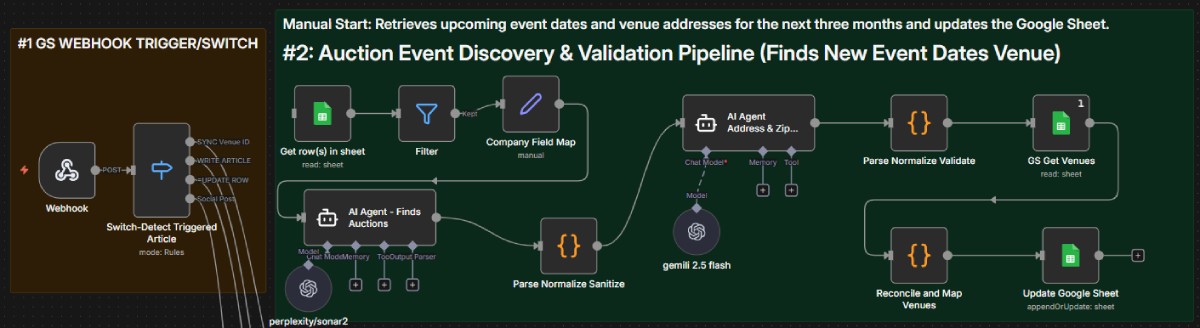
#2: Auction Event Discovery & Validation Pipeline
“Autonomous AI-assisted workflow that finds upcoming auction events and verifies, cleans, sanitizes, and normalizes venues details to maintain integrity”
The Problem: Manually monitoring 25+ elite auction houses—many of which host multiple high-volume auctions per year—is a massive labor drain that results in a permanent Research Bottleneck. Identifying new event dates across these platforms is an exhaustive process where critical events are frequently missed because data is fragmented across dozens of browser tabs. Furthermore, raw discovery leads often lack the “Gold Standard” details—such as precise venue names, verified street addresses, or official contact links—required for professional publication.
The Solution: I engineered an Autonomous Data Acquisition Engine that initiates high-intensity Discovery Sweeps to scan global auction calendars for a 3-month “Forward-Looking” window. This agent utilizes a Multi-Agent Collaboration, leveraging Perplexity/Sonar to identify new event dates and URLs. The payload is then handed off to Gemini 2.5 Flash, which performs Deep Intelligence Validation to verify the exact venue, normalize street addresses, and map the data into a structured JSON format.
The Result: The discovery and validation phase is compressed from days of manual “detective work” to seconds of automated processing. Management maintains a persistent, high-fidelity view of the auction market with zero manual research. This ensures the platform is always First-to-Market with 100% Database Integrity and accurate, publish-ready-ready information.
Definition: An Autonomous Intelligence Pipeline that utilizes specialized LLM reasoning and real-time web crawling to populate the Auction Staging Layer. It executes Schema Normalization and Data Sanitization on event metadata, ensuring every record meets the strict requirements of the downstream Article Architect.
(Click Image To Enlarge)
#3: The Auction Venue & State Management Agent (new)
“An automated workflow that verifies auction venue data, updates outdated records, and creates missing venue entries, using Data Validation, Schema Reconciliation, and WordPress API Synchronization to keep event records accurate.”
The Problem: Raw discovery data often lacks critical details—like verified street addresses or official venue IDs. Without validation, the database becomes cluttered with “Hollow Entries” (not valid) and duplicate records, leading to Data Drift and requiring hours of manual “detective work” to clean before publication. This leads to an auction event in missing or incorrect Venue data.
The Solution: I engineered the Auction Event Cleaner (AEC) to function as an autonomous auditor. This agent executes an Agentic Interrogation of the WordPress database using Gemini 2.5 Flash to reconcile incoming leads. Utilizing Boolean Logic, the agent verifies if a venue exists, validates the address accuracy, and executes an HTTP PUT to update any outdated records. If no venue is found, the agent autonomously researches the location, creates the new WordPress venue entity, and links it to the correct event record before synchronizing the final Production ID back to the Google Sheet.
The Result: Management maintains absolute Database Integrity without human oversight. This transforms a tedious manual reconciliation process into a sub-2-minute automated execution, ensuring the Source of Truth in the Google Sheet is always perfectly synchronized with the production environment.
Definition: A Data Integrity Pipeline that utilizes REST API integration and Multi-Model Verification to perform Schema Reconciliation. It eliminates duplicate records and “Hollow Entries” by enforcing strict Conflict Resolution logic across the entire auction database.
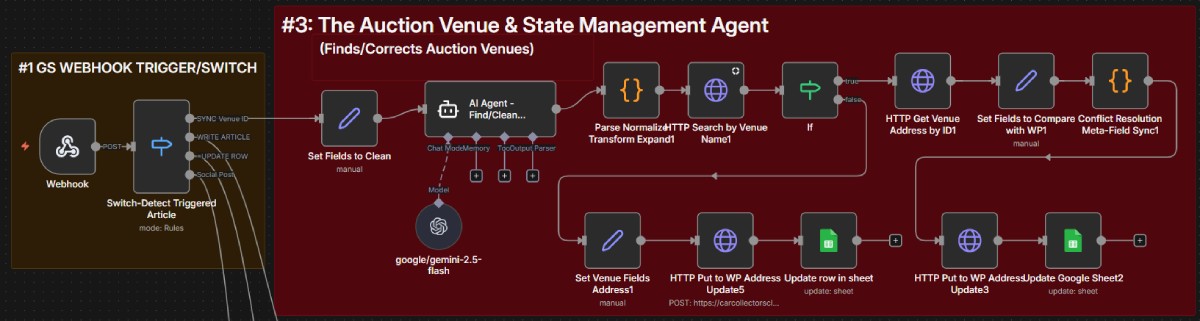
(Click Image To Enlarge)
#4: Auction New Article Writing Workflow
“An automated workflow that creates new auction articles from validated event data, using Content Generation Pipeline logic, Data Enrichment, and WordPress API publishing to produce SEO-ready drafts.”
The Problem: Producing high-quality, 1,000-word auction event articles traditionally requires hours of manual research into auction details. A strong, accurate article depends on gathering information such as vehicles for sale, prices, lot numbers, descriptions, featured collections, venue details, dates, times, and admission pricing. A typical event article can take 5 to 7 hours to produce. For a human team, scaling this level of content production across 25+ global auction houses and more than 100 auctions annually becomes prohibitively expensive and creates a major content ceiling that limits business growth.
The Solution: I engineered this multi-agent workflow to function as a lead editorial research assistant and technical article writer. Triggered by a single checkbox, it utilizes two AI models, including Perplexity/Sonar and Gemini 2.5 Flash, to synthesize a comprehensive, research-backed article. The workflow autonomously structures the post, manages HTML formatting, optimizes for SEO, and stages the content as a “Pending” draft in WordPress. The final step remains human-in-the-loop: a reviewer checks the article, inserts any final edits or media, and approves it for publishing.
The Result: This workflow transforms auction article production from a labor-intensive half-day task into a fast, scalable AI-assisted publishing process. Work that once required about 6 hours of manual effort at $25 per hour can now be completed in less than 15 minutes as a high-quality draft ready for human review. The result is lower production cost, faster publishing turnaround, and the ability to scale coverage across far more auctions without increasing payroll. This gives the company a practical way to expand content output while maintaining quality, consistency, and search visibility. ***
Definition: A Multi-Agent Generative Architect that synthesizes real-time web research and brand voice into a structured digital asset. It utilizes a Content Aggregator & Schema Mapper node to ensure complex metadata—such as lot numbers and venue details—are surgically injected via the WordPress REST API.
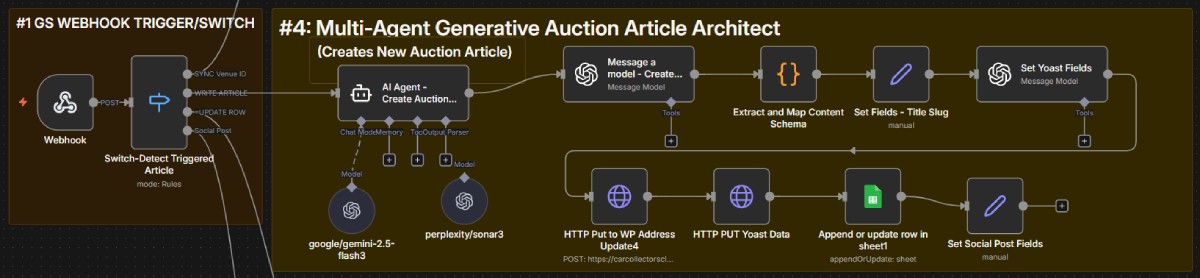
(Click Image To Enlarge)
#5: Published Article Sync Workflow
“An automated workflow that pulls live article IDs, URLs, and image data from WordPress into Google Sheets, using HTTP API Calls, Normalization, and Synchronization to keep records accurate.”
The Problem: Once an article is published in WordPress, the “Live” data (like the final Article ID, the public URL, and the featured image path) often remains trapped in the website database. This leaves the Master Google Sheet outdated, forcing staff to manually copy-paste URLs and IDs back into the spreadsheet for tracking.
The Solution: This agent acts as a Data Integrity Specialist. Triggered once an article is published and images are added, it executes an HTTP GET request to the WordPress REST API. It utilizes a specialized “Parse Strip Sanitize Normalize” node to extract the exact production metadata required.
The Result: 100% synchronization between Production and Management layers. The agent autonomously updates the Google Sheet with the live article links and IDs, ensuring that your “Source of Truth” is always current. This provides the foundation for 100% Marketing Attribution and downstream social syndication.
Definition: A State Management Agent that performs bi-directional synchronization between the WordPress production environment and the Google Sheets control layer. It utilizes automated Data Normalization to ensure that final production IDs are correctly mapped to the original auction record.
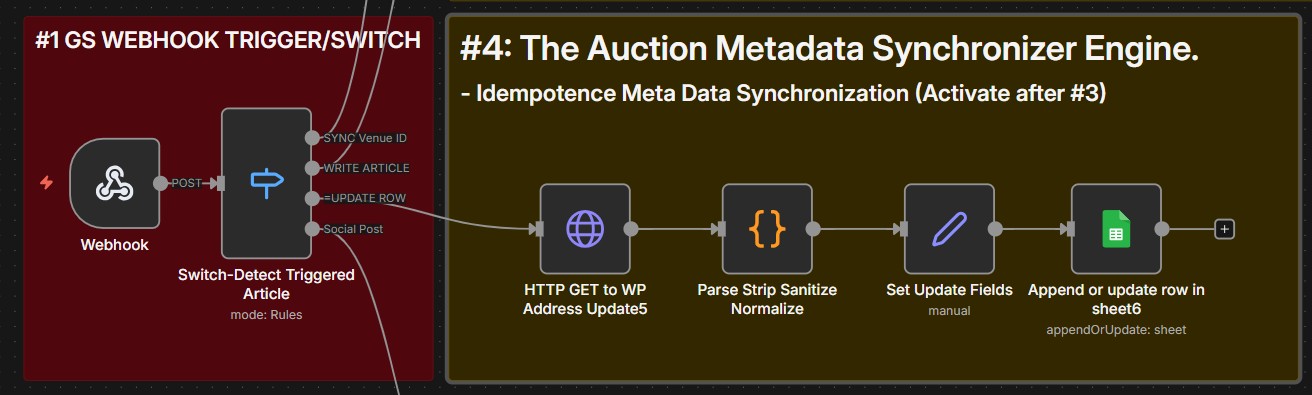
(Click Image To Enlarge)
#6: Social Media Distribution Workflow
“An AI-assisted workflow that converts published car show articles into platform-ready social posts, using AI Content Generation, Auto Hashtag Generation, and HTTP API Publishing to deliver fast, consistent visibility across Facebook, Instagram, and X.”
The Problem: Promoting upcoming auctions across Facebook, Instagram, and X (Twitter) is a repetitive, manual chore that often leads to “Data Fragmentation.” Manually reformatting lot details, managing image uploads, and ensuring hashtag consistency across three different interfaces consumes hours of marketing labor every week.
The Solution: This agent acts as an autonomous Marketing Director within the Agentic Workflow. Triggered by the Post_Social_Media checkbox, it initiates a Multi-Agent Collaboration using Gemini-1.5-Flash to generate tailored captions. It utilizes a Hashtag Metadata Normalization Mapper and Parallel API Execution to push content to Facebook, X, and Instagram simultaneously.
The Result: The brand maintains a 24/7 global social presence with zero manual effort. Through precision Agent Orchestration, the system manages API “Wait” states and technical reformats, ensuring every auction lot receives immediate visibility. This process concludes by logging all live Social Post IDs back to the master sheet for 100% Marketing Attribution.
Definition: An Autonomous Agentic Content Syndication engine that utilizes parallel processing and platform-specific payload formatting. It features an Entity Decoder & Mapping Sanitization layer to ensure brand voice and data integrity are maintained across the entire social graph.
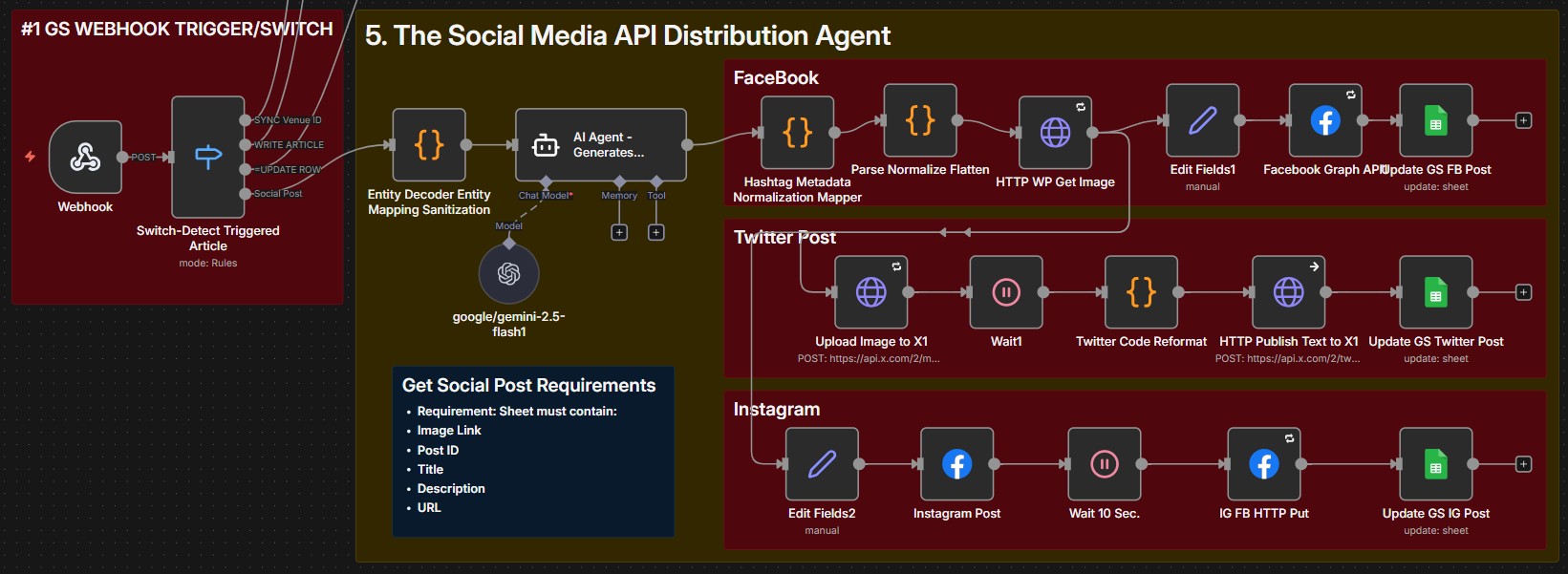
(Click Image To Enlarge)
☑ One-Click Activation & Workflow Management
“Simple Front-End Control for Complex Back-End Intelligence”
The Command Center: One-Click Activation
“☑ Simple Front-End Control for Complex Back-End Intelligence”
Workflow Logic Quick Summary:
The “Car Auction Events” Google Sheet serves as the Command Interface. When a checkbox (☑) is toggled, it triggers a Row-Level Transmission to an n8n webhook. The system parses the data, confirms the trigger status, and directs the payload into the appropriate Downstream Branch for autonomous processing.
- The Interface: The Google Sheet serves as the Operational Dashboard. No coding or technical logins are required.
- The Trigger: Simply toggle a Checkbox (☑) on any Car Auction row to initiate the automation.
- The Logic: A Webhook instantly transmits data to n8n, where a Switch Node identifies the requested task (Validation, Syncing, or Publishing).
- The Result: The workflow executes autonomously, and the final status is logged back to the sheet in real-time.
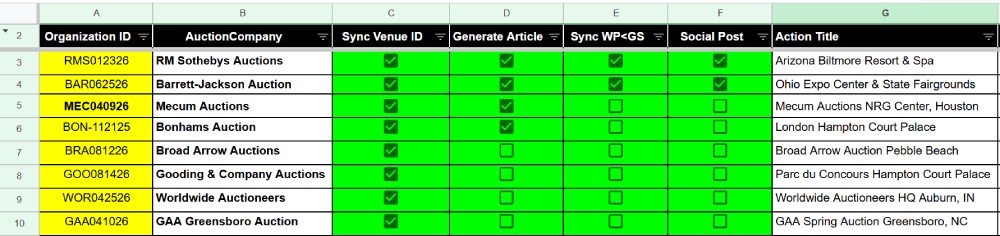
(Click Image To Enlarge)
Diagram: Six Multi-Agent Workflows For “Car Auctions”
CarCollectorsClub.com | case study
CAR CLUBS
#3: MULTI AGENT ORCHESTRATION
“An autonomous multi-agent orchestration engine designed to scale car club coverage through automated club discovery, contact and address verification, record reconciliation, SEO content creation, SEO-optimized publishing automation, and multi-channel social syndication.”
Clubs Car Auctions Multi-Agent Overview
The Autonomous Car Club Data & Publishing Ecosystem Architectural Solution
The Problem:
We were drowning in a manual data bottleneck. Managing hundreds of Car Clubs across disparate Google Sheets and WordPress databases led to severe Data Drift. Our team wasted days manually validating addresses, finding contacts, writing articles, and posting to social media. This error-prone process made it impossible to scale the directory, stalling our growth and compromising our data integrity.
The Solution:
I engineered a Self-Healing Multi-Agent Ecosystem using n8n orchestration. This central Intelligence Engine synchronizes four distinct pipelines: Address & Contact Validation, WordPress Record Reconciliation, Automated Article Generation, and Omnichannel Social Distribution. The system uses a Hybrid Architecture of JavaScript logic and Multi-Model AI Agents (Gemini 2.5, Perplexity) to manage the entire data lifecycle.
The Results:
This ecosystem transformed a disjointed manual operation into a High-Velocity Digital Asset. We achieved Near-Instant Synchronization between Google Sheets and WordPress, reducing the total operational workload from 40 hours a week to under 5 minutes of automated execution. CarCollectorsClub.com now operates with a Single Source of Truth, allowing us to scale our content and directory footprint autonomously with Near 100% Accuracy.
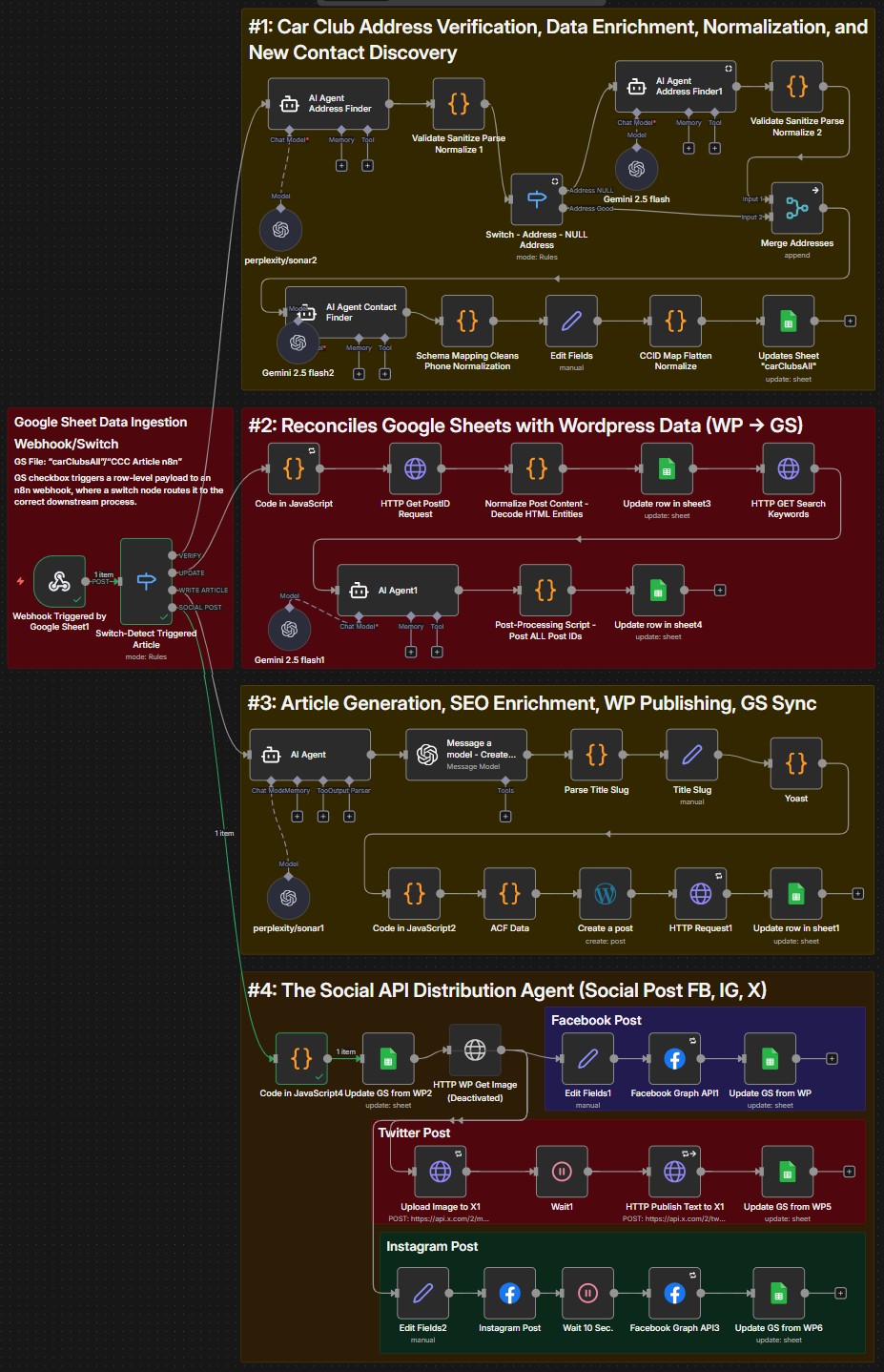
#1: Complete Car Club Contact & Address Verification Pipeline
“An Autonomous Multi-Stage Data Enrichment Pipeline using Heuristic Validation, Relational Discovery, Normalization, and Schema Mapping to verify car club records and produce production-ready directory data.”
“Dirty Data” was our primary bottleneck, creating an error-prone and time-consuming manual workload. New Car Club entries frequently arrived with broken addresses and missing contact details. This forced us into a grueling cycle of searching URLs and Google Maps for verified information, making it impossible to scale our directory at market speed.
The Solution: I engineered a Multi-Stage Enrichment Pipeline to automate verification. The workflow executes Heuristic Address Validation with Autonomous Retry Logic for missing results. Once verified, the system performs Relational Contact Discovery to extract live officer data. Finally, it normalizes all attributes into a structured schema for seamless Google Sheets integration.
The Results: This Agentic Data Cleansing suite achieved near 100% Address Integrity across our database. We eliminated manual research, slashing onboarding time from 60 minutes to under 15 seconds. CarCollectors.com now offers a professional, near “Zero-Error” experience, allowing our car club directory to grow autonomously without human intervention.
Workflow Definition: This workflow checks a car club’s address, corrects it if needed, retries the address lookup when the first result is missing, merges the best address result, then uses that verified location data to find new contact information. After that, it cleans, formats, and normalizes the contacts and writes the final structured data back into Google Sheets.
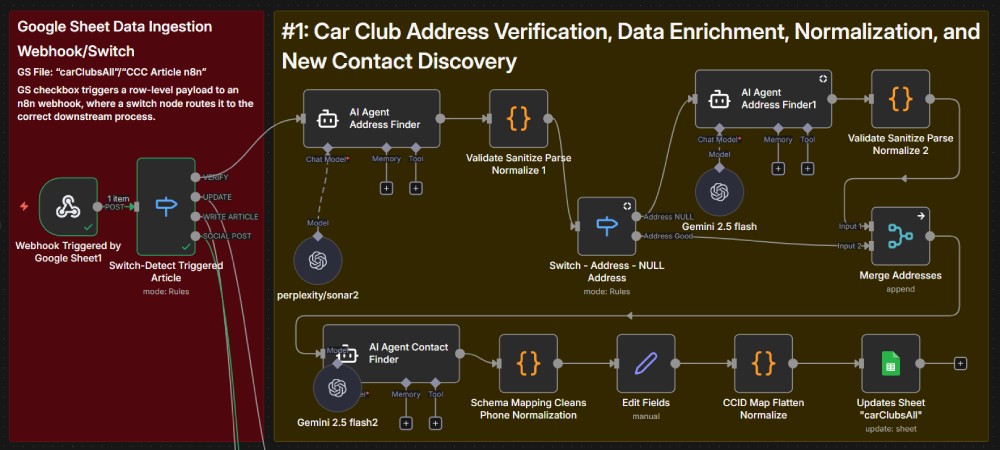
(Click Image To Enlarge)
#2: The WordPress & Google Sheets Master Sync
“An automated workflow that matches WordPress posts with Google Sheets records, restores missing Post IDs, and uses Reconciliation, Normalization, and Bi-Directional Synchronization to keep both systems aligned.”
The Problem: Managing a massive directory across two platforms created a “Data Gap.” Our spreadsheet and website were frequently out of sync, causing broken links and missing IDs. We wasted hours manually cross-referencing records to ensure the live site matched our master data. This “Data Drift” made reliable updates impossible.
The Solution:
I engineered a Record Reconciliation Engine to bridge this gap. The workflow executes a Bi-Directional Lookup to match rows with live WordPress IDs. An Autonomous Recovery Agent identifies missing matches, while the system performs Content Normalization to strip HTML artifacts before syncing the final, cleaned data.
The Results:
This suite eliminated manual cross-referencing, transforming a four-hour weekly audit into a 30-second automated execution. By achieving Near 100% Data Alignment, CarCollectorsClub.com now operates from a “Single Source of Truth.” We can now push instant website updates with zero risk of data mismatch or corruption.
User Definition: This workflow matches GS records with WP posts, confirms or recovers the correct Post ID, cleans the returned content, and writes the updated data back into Google Sheets. It also uses an AI agent to perform additional steps that identify missing matches and save the final results.
(Click Image To Enlarge)
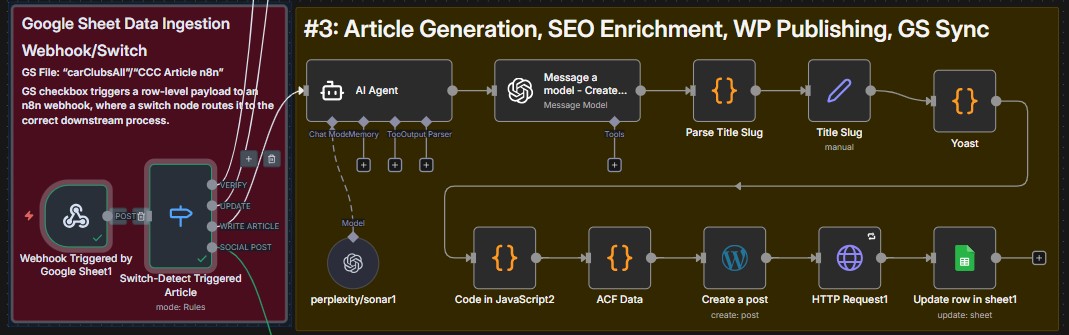
#3: Car Club Article Writing Workflow
“An automated workflow that turns car club data into published WordPress articles, using Content Synthesis, SEO Enrichment, and Data Reconciliation to keep content and records aligned..”
The Problem:
Creating high-quality, SEO-optimized articles for hundreds of Car Clubs was a massive manual burden. Writing unique descriptions, mapping metadata, and manually publishing to WordPress created a content bottleneck. We couldn’t scale our directory fast enough, and manual entry often led to inconsistent formatting and missing SEO fields.
The Solution:
I engineered a Multi-Agent Content Pipeline that automates the entire publishing lifecycle. The workflow utilizes Perplexity and Gemini Agents to synthesize club data into structured articles. It automatically maps SEO metadata via Yoast, generates WordPress Custom Fields (ACF), and publishes the post before reconciling the new Post ID back to Google Sheets.
The Results:
This “Article Architect” transformed our content department into a high-velocity engine. We eliminated the need for manual writing and formatting, slashing the time-to-publish from 45 minutes per club to under 60 seconds. This allows CarCollectorsClub.com to scale its digital footprint autonomously with Near 100% Content Consistency.
Workflow Logic Summary:
This workflow ingests Car Club data via Webhook to trigger a dual-agent writing process. It cleans raw inputs, generates SEO-ready metadata, and handles the full WordPress REST API handshake for publishing. The final step ensures System Synchronization by writing the live URL and Post ID back to the master database.
(Click Image To Enlarge)
#4: Autonomous Social Media Distribution Workflow
“An automated workflow that turns published car club articles into platform-ready social posts, using Content Transformation, API Distribution, and Reconciliation to keep promotion fast, consistent, and fully tracked.”
The Problem:
Manual social media distribution was a significant growth killer. Manually reformatting articles, resizing images, and scheduling posts for Facebook, Instagram, and X consumed hours of creative time. This disjointed process led to inconsistent posting schedules and a “lag” between website publishing and social visibility, stalling our audience engagement.
The Solution:
I engineered an Automated Syndication Engine that translates WordPress data into platform-specific assets. The workflow utilizes API-Driven Transformation to generate optimized hashtags and captions. It programmatically retrieves featured images via the WordPress REST API and executes a Parallel Distribution Sequence to Facebook Graph, Instagram, and X (Twitter) APIs.
The Results:
This suite achieved 100% Syndication Coverage across all major platforms with zero manual effort. By automating the post-transformation and delivery, we reduced the distribution cycle from 30 minutes to seconds. CarCollectorsClub.com now maintains a continuous, Near-Instant Social Presence, maximizing SEO signals and engagement without increasing staff overhead.
Summary:
This workflow ingests Car Club article data and transforms it into platform-ready posts for Facebook, Instagram, and X. It cleans metadata, retrieves live WordPress images, and executes direct API handshakes for publishing. The final step ensures GS Reconciliation by logging successful post IDs and timestamps back to the master database.
(Click Image To Enlarge)
☑ Easy One-Click Activation & Workflow Management
“Simple Front-End Control for Complex Back-End Intelligence”
The Command Center: One-Click Activation:
“☑ Simple Front-End Control for Complex Back-End Intelligence”
Workflow Logic Quick Summary:
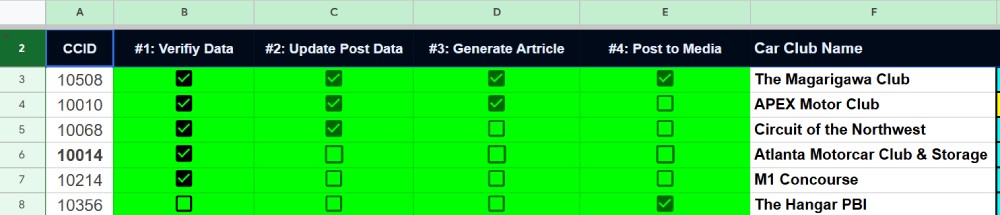
The “carClubsAll” Google Sheet serves as the Command Interface. When a checkbox (☑) is toggled, it triggers a Row-Level Transmission to an n8n webhook. The system parses the data, confirms the trigger status, and directs the payload into the appropriate Downstream Branch for autonomous processing.
- The Interface: The Google Sheet serves as the Operational Dashboard. No coding or technical logins are required.
- The Trigger: Simply toggle a Checkbox (☑) on any Car Club row to initiate the automation.
- The Logic: A Webhook instantly transmits data to n8n, where a Switch Node identifies the requested task (Validation, Syncing, or Publishing).
- The Result: The workflow executes autonomously, and the final status is logged back to the sheet in real-time.
(Click Image To Enlarge)
Benefits: Scalable ROI through Automation
“Simple Front-End Control for Complex Back-End Intelligence”
Scalable ROI through Automation
The Operational Reality Before this orchestration, managing a single Car Club record was a multi-day manual project requiring high-level research and technical precision. The “Human Bottleneck” made scaling the directory impossible, as the density of data required—from unit counts and amenities to SEO formatting—consumed nearly a full day of skilled labor per entry.
| Pipeline | Manual Labor Required |
AI Orchestrated Speed
|
| #1: Data Verification | 60 Minutes (Manual Search & Audit) | < 60 Seconds |
| #2: Database Syncing | 30 Minutes (Cross-referencing WP/GS) | Instant |
| #3: Article Synthesis | 6 – 8 Hours (Research, Writing, SEO) | < 2 Minutes |
| #4: Social Syndication | 45 Minutes (15 min per platform) | < 30 Seconds |
| TOTALS | Approx. 9 Hours per Club | Under 5 Minutes |
The Bottom Line & Savings:
Time Reduction (97.2%):
-
Math: $(540 \\text{ mins} – 15 \\text{ mins}) / 540 \\text{ mins} = 0.9722$
-
Consultant Verdict: Your use of 96% or 97.8% is very close, but 97% is the most defensible “conservative” number for time savings.
By replacing 9 hours of manual labor with a 15-minute automation sequence, we achieved a 3,500% increase in operational velocity. This ecosystem effectively eliminates the overhead of a full-time content department, reducing the production cost per record by 97.2%. CarCollectorsClub.com is now a High-Moat Digital Asset, capable of scaling its directory and social presence at a speed that is physically impossible for traditional competitors to match.
Diagram: Six Multi-Agent Workflows For “Car Clubs”
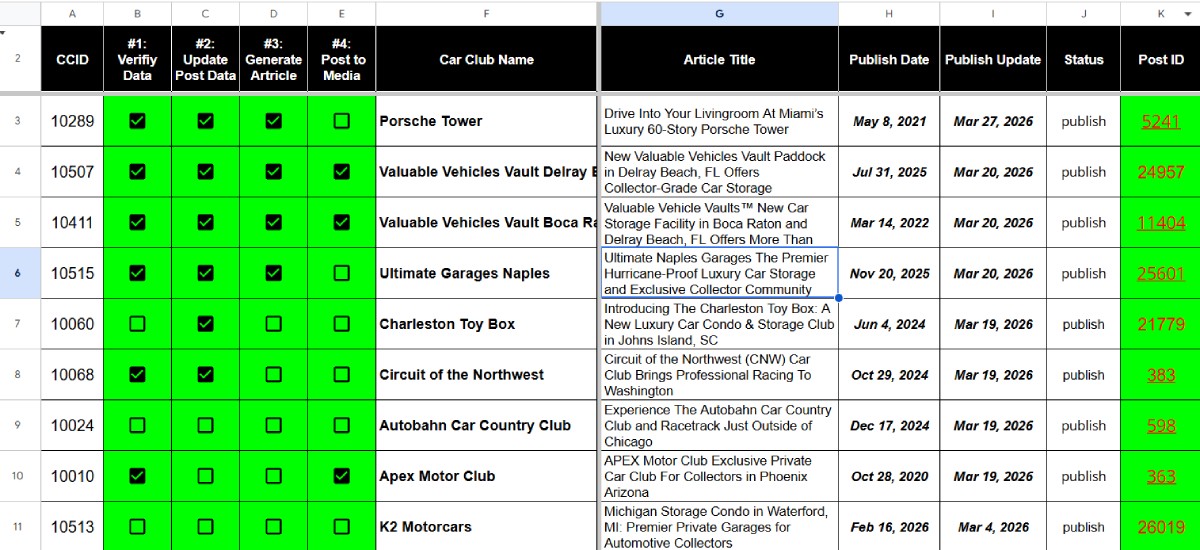
“This Smart Dashboard turns a complex manual process into a simple, One-Click Solution. By checking a single box in a Google Sheet, any team member can instantly launch an AI Digital Workforce. This Automated Pipeline handles the ‘detective work’—automatically verifying event dates, writing SEO-ready articles, and syncing data across the entire website. This No-Code Interface eliminates the need for technical skills or manual data entry, providing Real-Time Accuracy and a massive competitive advantage with zero effort.”
(Click Image To Enlarge)
Additional Utilities and Tools
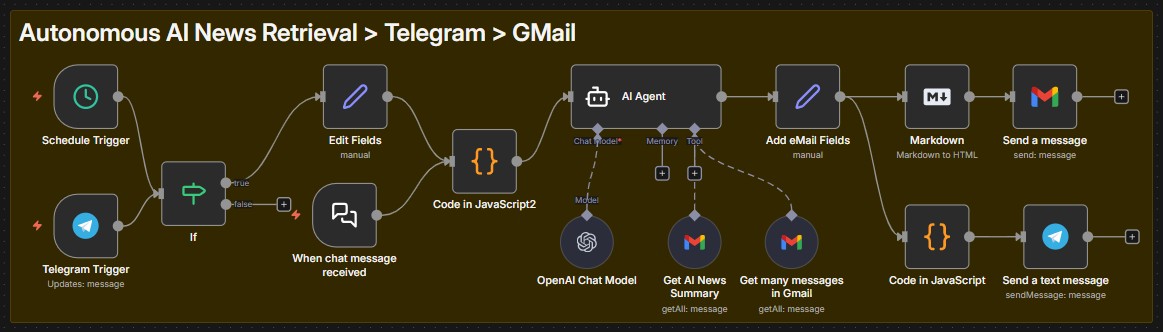
“An autonomous AI email assistant that monitors my inbox, identifies incoming AI newsletter emails, merges and organizes the most relevant updates, writes a concise summary, and forwards the final digest to both Gmail and Telegram at a scheduled time—eliminating the need to manually sort through hundreds of emails each day.”
(Click Image To Enlarge)
Autonomous AI News Briefing Workflow
#2: The Autonomous AI News Curator
Multi-Agent Workflow for Intelligent Newsletter Aggregation and Distribution
The Problem:
Subscribing to dozens of AI newsletters created a daily information bottleneck. Important updates were buried inside hundreds of emails, forcing a time-consuming manual process of scanning subject lines, opening messages, identifying duplicates, and deciding what was actually worth reading. This inbox overload reduced operational focus, slowed information retrieval, and made it difficult to consistently capture the most valuable AI news in a usable format.
The Solution:
I engineered an Autonomous AI Agent to function as a 24/7 Digital Workforce for newsletter triage and summarization. This Workflow Engine automates the Ingestion of targeted newsletter emails, filters relevant content, and uses a Content Synthesis Pipeline to merge, de-duplicate, organize, and summarize the most important updates into a single high-value digest.
The Result:
Instead of manually sorting through hundreds of fragmented emails, I now receive a concise AI news briefing delivered automatically to both Gmail and Telegram at a scheduled time. This transformed a high-friction inbox into a streamlined Distribution Pipeline, reducing a large daily reading burden into a fast, reliable 2-minute summary.
Technical Definition:
An End-to-End Workflow that uses Gmail-based Ingestion, filtering logic, and Multi-Agent summarization to aggregate newsletter content into a normalized digest. It performs Parsing, Normalization, and Content Generation before distributing the final output through Telegram and Gmail using API-driven workflows and downstream message delivery.
(Click Image To Enlarge)
AI Autonomous Car Club Media Consultant:
David Stoyka 561-324-2946
myfirst100@gmail.com